Tuesday, April 29, 2014

Breaths Per Lifetime

I was hiking up a mountain at fairly high altitude and this naturally got me to thinking about breath.  I wondered how many breaths there are in a lifetime.  How many are in a day?  How many days in a lifetime?  Doing the calculation in my head, between labored breaths, led me to realize that very approximately, there are about as many breaths in a day as there are days in a lifetime.

That's fascinating.  And it might lead to some interesting analogies.  Let's see.

We start out breathing faster, then slow down gradually, and we breath slower at night.  I wanted to take these things into consideration so I put together a spreadsheet based on numbers from these sources:

And why not throw in heart beats as well:

Here are the main numbers:
per lifetimeper day
femalemalefemalemale
breaths783,861,539731,266,61929,23929,271
heartbeats3,116,459,3902,781,534,939116,248111,339
days26,20924,98311

The number of breaths per day is indeed very close to the number of days per lifetime.  This could be interpreted to mean that each breath represents one day of our lives.  That each breath recapitulates a day.  This should help remind us of our mortality, right?

Let's see what that looks like.  We will take one day and map our life onto it, breath by breath.  (Our lifetime doesn't cover a complete day because there are somewhat fewer days than breaths.) Let's start from the moment we fall asleep.  10PM is our bedtime, and we will sleep 8 hours, waking up at 6AM.  Here is a table showing how old we are at each hour of this day. We wake up at the age of 25, having breathed about 9000 breaths.  We've finished breakfast by age 32, and we clock in at work at age 35.  We clock out at 63.  Dinner has been eaten and the dishes are washed by age 70.  Bedtime is at 80. (These numbers are in the "sleep first" column in the table below.)

(We could also start our allegorical life upon waking, and those numbers are shown in the "wake first" column.)

hour sleep first wake first
10:00:00 PM 0.0
11:00:00 PM 3.1
12:00:00 AM 6.3
01:00:00 AM 9.4
02:00:00 AM 12.5
03:00:00 AM 15.6
04:00:00 AM 18.8
05:00:00 AM 21.9
06:00:00 AM 25.0 0.0
07:00:00 AM 28.5 3.4
08:00:00 AM 31.9 6.9
09:00:00 AM 35.4 10.3
10:00:00 AM 38.8 13.8
11:00:00 AM 42.2 17.2
12:00:00 PM 45.7 20.7
01:00:00 PM 49.1 24.1
02:00:00 PM 52.6 27.5
03:00:00 PM 56.0 31.0
04:00:00 PM 59.4 34.4
05:00:00 PM 62.9 37.9
06:00:00 PM 66.3 41.3
07:00:00 PM 69.8 44.7
08:00:00 PM 73.2 48.2
09:00:00 PM 76.7 51.6
10:00:00 PM 80.1 55.1
11:00:00 PM 83.5 58.2
12:00:00 AM 87.0 61.3
01:00:00 AM 90.4 64.5
02:00:00 AM 93.9 67.6
03:00:00 AM
70.7
04:00:00 AM
73.8
05:00:00 AM
77.0
06:00:00 AM
80.1
07:00:00 AM
83.2
08:00:00 AM
86.4
09:00:00 AM
89.5
10:00:00 AM
92.6

Tuesday, February 11, 2014

Food

There are currently about 7.1 billion people on the planet1.  The average American eats about ton of food per year, and the poorest average about half that2.

That works out to 4.8x10¹²kg, which, compacted, would make a ball about 2km in diameter3.

Here it is compared to some other objects:

namediametermass
Great Pyramid of Cheops0.14x0.23km5.4x109kg
Three Gorges Dam0.18x2km3.4x1010kg
just the meat40.76km2.7x1011kg
asteroid: 1999 KW41.5km2.4x1012kg
asteroid: 1620 Geographos2.0km4x1012kg
how much we eat in a year2.0km4.8x1012kg
asteroid: 2002 CE263.5km2x1013kg
Halley's comet8-15km3x1014kg

To further help comprehend the dimensions, here is a list of the world's tallest buildings.

1 - world population
2 - average food consumption (I used the average of the two numbers)
3 - mean density of compacted food waste is about 1029 kg/m3.
4 - The size of the meatball we consume each year, as a species. See source.

Saturday, February 1, 2014

Explorable Universe

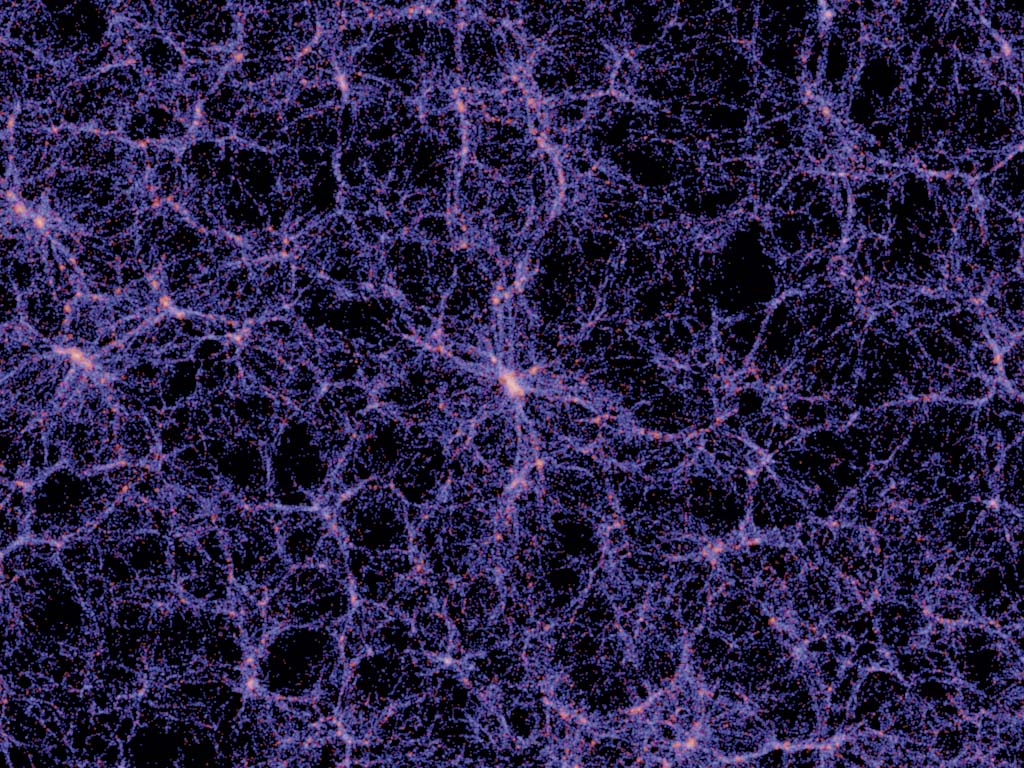
Ever since I saw the peculiar, foam-like arrangement of galaxies, I was intrigued.  Here is an example of what I'm referring to.  Every point of light in this image is an entire galaxy.


This inspired me to create a fly-through visualization that lets you explore nearby stars, galaxies and galactic clusters.  Please be patient while it loads all the data, there's 4MB of galactic cluster data and 2MB for the stars, so it takes a minute or so the first time you load it.
* http://marklipson.com/code-samples/galaxies1/galaxies.html

My favorite is the "galaxy" view - you can see the clustering of galaxies, and you can more or less see the filaments and voids.  The "cluster" view may not quite be correct yet, and the radii and brightnesses could all use some work.  But it gives you a sense of where we are in the universe, which was its purpose.  If any programmers or astronomers feel inspired to help, the code is here.


For a more visually gratifying fly-through, here is one based on the terabytes of data gathered by SDSS:
* http://www.youtube.com/watch?v=08LBltePDZw

Here's a great little demonstration of the scales involved:
http://htwins.net/scale2/

And I can't help but include a link to this article about what might lie beyond the meager confines of the observable universe:
http://scienceblogs.com/startswithabang/2010/10/27/how-big-is-the-unobservable-un/


Thursday, May 23, 2013

Prime Roots

What's in a number?  Well, prime roots, for one thing.  I'm sure there are many other "significant" ways to understand a given integer, but prime roots seem like they get at some kind of fundamental essence.  Take 12, for instance.  2, 2 and 3.

Just for fun, let's pretend that quarks represent prime numbers.  If up quarks were "2", and down quarks were "3", that would give you a proton, so a proton would be 12.  A neutron would be 18, since it has 2 down quarks and 1 up quark (2, 3 and 3).  We might have to create some imaginary quarks to go much further, but this obliquely conveys my excitement about prime roots being "fundamental building blocks of numbers".

Not seeing a particularly simple prime root calculator, I created this:
  prime root finder

Acceleration

How strong is the gravitational pull of Jupiter from Earth?  On average, it turns out to be 0.2 micrometers per second per second (between 0.147 and 0.32, depending on how close we happen to be).  That doesn't seem like much, but after an hour you would have moved about 4 feet, and after a day you would have gone 780 meters and would be moving at a more noticeable 2cm/second.

That's only 1/160th the strength of the Moon's gravity, which causes tides.  And the Moon's pull is 1/180th that of the Sun's, which is 1/1700th of the familiar gravity on Earth's surface.

But it's still strong enough to be noteworthy.  Even at about 1/50 millionth of what we consider normal "falling", it would be quite noticeable under certain conditions.  For instance, if your keys suddenly lost their responsiveness to all gravity save Jupiter's, they would be on the ceiling (or wall, or floor, or under the bookshelf) well before morning.

Before considering this attraction to be small, we should consider that the gravity on Earth's surface is really quite huge.  If you were to free fall in Earth's gravity for only 47 minutes you would have gone far enough to circle the globe (not including atmospheric drag, of course).  So a 50 millionth of that still seems significant.

Enough to lose one's keys overnight, anyway.


The Sun is a reference point between those extremes that we can use to help conceptualize this amount of pull.  If you were to fall off the edge of the Earth, toward the Sun, it would take 18 seconds to fall your first meter but within an hour and a half you would have cleared the atmosphere.

For another reference point, the acceleration toward the galactic center is about 8 femtometers per second per second, 24 million times weaker than toward Jupiter.  At that rate, you would only fall 4 meters in your first year, and only 30km in your entire lifetime.  But it manages to swing the entire solar system around in a circle every 220 million years.  So you can't say it isn't strong.  You would just have to be very patient to notice it.

Unchecked attraction, more often referred to as "falling", can quickly get quite out of control.  If you were to fall at the familiar, Earthly rate for just a minute (ignoring friction), you would have gone over 10 miles and would be going 1300 mph.  Fortunately, there is a stable way to relate to gravity: by orbiting.  This arrangement lets you continuously fall, but with a nice, smooth mix of angular momentums that prevent you from picking up too much speed.

And speaking of falling in circles, we are already doing that, and at impressive speeds.  The rotation of the earth causes us to move a little over 1000 mph (at the equator).  But the Earth is orbiting around the Sun much faster than that: at about 67,000 mph.  And our solar system's orbit around the galactic center is even faster: over 500,000 mph.  And our whole galaxy is moving even faster than that: somewhere in the neighborhood of 900,000 mph, depending on what you measure against.

All of these various fallings make up the fabric of our local space-time continuum, this familiar, invisible grid that we assume to be Euclidean but is in reality quite lumpy.  Jupiter, being the strongest gravitational influence after the Moon, represents a frontier of unacknowledged lumpiness.

(It's really more of a slowly varying incline.  But if you look at the shape of space-time across the whole solar system, "lumpy" seems a better term.)

In any case, even if one's keys are not likely to be sucked into outer space by Jupiter's gravity, it is fascinating to imagine the effects of that force, subtly mixed into the the more potent gravities in our lives.

One last calculation.  Two humans, placed in outer space with about a foot between them, would take about 3 hours to fall into each other.  This force of attraction is about 1/18th that of Jupiter's.

Lumpy indeed.