Wednesday, December 26, 2018

Sacred Mundanity

On a whim I purchased a blue mylar balloon for my toddler.  Such balloons last a while, so it meandered around the house, following the whims of the child and of the air circulation system.  It ended up in a corner of the playroom one morning.  At that time my morning prayers were taking place right around sunrise, some time in a cloudy part of spring.  I was just beginning and it was time to venerate the icons.  When I arrived at the Theotokos, I found that the blue ball the child Jesus in her arms was overpoweringly bright and I could not look directly at it.
Our Lady of Valaam
Fortunately I was in the midst of prayer, so analyzing it was far from me.  I thanked her, and carried on.  Of course, the sun had just happened to come out from the clouds, the balloon had just happened to drift close to the window, and the brilliant shaft of blue light happened to illuminate the icon in just the right place.  It would be easy to follow a course of skepticism and attribute the whole thing to chance and to my own miracle-hungry state.  The rules of physics were all followed obediently in this case, leaving that dark hole of self destructive cynicism technically open to me such that I had to consciously choose not to climb into it.  But a much larger window was open at the same time, allowing me to accept the unexpected and undeserved gift.

Miracles of this sort are good practice for overcoming reductionist habits.  It's strange to reflect on how obvious God's presence is, yet this dark hole of denial remains irrationally present.  I call it strange because this denial has absolutely no way of winning a fair fight, intellectually, metaphysically or otherwise.  Yet it manages to crawl back and present itself over and over again.  Worse than its tenacity, I see myself glancing in its direction as if it were a real option, and having to recapitulate over and over again what I have learned.

The new ammunition that this dark outlook has purchased is that I am undeserving of anything like a miracle and therefore it is all prelest.  Of course I am undeserving, and of course I need to watch out for prelest, so this part of the argument draws me in.  But the hook is a rejection of God's goodness.  God grants us, even me, these "apparently mundane" miracles in abundance.  So frequently that the danger of prelest is sufficiently low for my state.  The danger becomes instead that I fail to recognize the free gift.

If an experience fills me with an appreciation and love for God, that can feel quite amazing, but I have to recognize that I'm only seeing a reflection of a reflection, and that's probably all I can handle in my present decrepit spiritual state.  Have I seen the uncreated light?  No, certainly not yet.  But have I participated indirectly in the energies of God?  Of course I have.  God's love is unescapable.  The form I'm referring to is somewhat like antidoron, in that you get some for free just by showing up.

There was a realization and re-assertion, some time many centuries ago, that Donatism was wrong, and that the grace in the sacraments does not depend on the sanctity of the officiant.  It's a surprising and non-intuitive conclusion that one is nonetheless drawn to over time, and one cannot get away from it.  God came to earth to save sinners; therefore His techniques are designed to work for sinners.  As long as you show up you get something.  Certainly you get more through diligence, resolve and ascesis.  But the Gifts are all out of proportion to the sacrifice we make on our end.

"If they won't listen to Moses and the prophets, they won't listen even if someone rises from the dead" - Luke 16:31

And they won't listen to miracles either.  These lesser miracles can appear to be created by our faith, because without faith we cannot see them.

A non-religious family member of mine came to a church service and I found myself wanting the experience to be profound for her.  Every time someone coughed or forgot a line, or sang off key I felt somehow that my dearly beloved family member would not be sufficiently impressed and would not grow closer to the faith with me.  I knew I was being silly.  After a while I remembered to pray about it.

I realized I was being a Donatist.  I was once talking to a freshly baptized person who was worried that she was not feeling anything.  The reply that jumped out of my mouth was that it was like getting married.  Even if you don't quite realize what you've signed up for right away, it will certainly come and find you.  There is a change of state that takes place which, even if not obvious from up close, is quite obvious from a distance.  The service doesn't have to be sparkly and filled with visible angelic light to be effective.

This mundane feeling is what clay feels like.  It is dull, and it goes about things in a clunky, mechanical way. But it has been given a real heart, that is real Breath, so it struggles in this awkward, lumpy way to climb up into the light, to imitate the goodness it sees.  When it recognizes its Maker, it's heart leaps and for a moment we forget our rather forgettable clay-ness.

"But we have this treasure in earthen vessels, that the excellency of the power may be of God, and not of us." - 2Cor 4:7

We have to bear with clay-ness for a good long while and let these Gifts percolate.  Over time as I find myself asking God, 'Would it be possible for me to approach You a little faster?' I begin to understand more clearly that the hold-up is not on His end.

Sunday, December 16, 2018

Infinity

"It is impossible for any procedure to lead to the isotherm T = 0 in a finite number of steps." - Nernst, 1912

When we say that God is infinite, I can't help but reflect back to mathematics and want to clear something up. In mathematics there is no concrete thing called infinity which happens to be larger than all other numbers. There is no such thing. Infinity is a formulation, a theoretical arrow pointing in a direction. There is no real number which you can divide into 1 and get 0. No real number, hear that? None at all. The entire, infinite world of numbers does not, itself, contain infinity. This is important.

Because God is bigger than the world, bigger than His creation. Bigger than math.

This implies something important about the manner God appears within the world, i.e. through Christ's human nature. It is... get ready for it... finite. Like us.

When we look out on the vast, apparently infinite universe, and wonder, "how can God care about us, we are so small?" I think it's important to remember that, besides the fact that He is everywhere present and filling all things, He also has deep, intimate familiarity with finitude. He made it, after all.

And, it's also important to remember that even finitude is infinite, so to speak. There are an infinite number of numbers, but every one of them is finite, bounded, limited, constrained in its essence. Jesus was (and is) God's expression into a finite canvas. An expression which completely embodies the fullness of the Father, yet is expressed in terms of the finite.

Does this mean that Jesus's human nature was bound to the constraints of finitude? By no means! There is a bridge at work here between the finite and the infinite. The finiteness of the finite is, in some respects, made illusory, or rather transcendable through Christ. We do not exchange our finiteness for infiniteness (in this life) but rather we are carried across this bridge through faith in Christ, being pulled along as it were, by the cords of relatedness, by His renewal of our nature through the Resurrection. Or, more simply put, God's Love, through Christ, transforms us as we enter into it, cleanses us of the corruption of finitude, and returns our nature to its original created state ("that ancient beauty"). No longer purely finite, mortal and corruptible, but now a finite expression of God's infinitude. No longer the muddied and turbulent water reflecting the image we become the reflection of the image in the pure, still water.

The opening quote is one I've always loved to hear. As I see it, in this quote, physics admits something elusive but very important. If the physical world does not contain zero (or, it requires an infinite amount of energy to reach zero, same thing), then physics is not describing the "ground of being". We can't see absolutes through physics. No, we can't just not see them, we can't experience them. We can't reach zero by forcing something in the world to look like zero. Long ago we agreed that we were not able to reach infinity through the world. But it took a while to acknowledge that we can't even reach zero.

One more bit of physics that pairs nicely with the third law of thermodynamics: scalar fields, namely the Higgs field. It is another example, an even more stark example, of our admission that the physical world is permeated by mysterious force. It is not built from nothing, it is built on mysterious forces. Nothingness (and therefore the ground of being, and the roots of something-ness) is therefore much deeper.

"... the universe begins to look more like a great thought than like a great machine" - James Jeans

Something is more fundamental than matter, energy, time and space. As a medium of expression, the 'universe' can only approximate truth, can only point to it. But the universe is at its core a creation of, i.e. an expression of truth. So it is in fact possible to genuinely express and point toward truth through this universe. Genuine truth that is symbolically represented 'in the world' points to real truth. When we pass over that bridge and enter into God's likeness, we do not exit the finite and enter the infinite. Rather, we become cognizant of the Theophany of uncreated light shining through us and sustaining us. The finite is renewed through contact with the infinite.

The point, I think, is that to the extent we think God is out of our reach because He is infinite, we are wrong. Any increase in our awareness of the size of the universe detracts not at all from God's accessibility. And to the extent we think that any expression, even of the infinite, within finitude is doomed to corruption and decay, we are also wrong. Truth, even Ultimate Truth can, has, and does express Itself in tangible ways. And, perhaps most importantly, our finitude does not bar us from the Kingdom. There is a Bridge, humbly and generously offered to us in loving self-sacrifice, by which we may pass.

Sunday, December 13, 2015

The Size of the Genome

A prevalent assumption is that everything that makes us human, from the shape of our bones to the shape of our personalities, comes from DNA.  Most accept that at some point the influence of DNA trickles out and other influences take over.  But where is that point?

I think that extending the realm of DNA very far past "mere form" exaggerates what is possible given the amount of information contained in the human genome.

The human genome contains "approximately 3 billion base pairs", according to the Human Genome Project.  Each base pair can be either GC, CG, AT or TA.  There are four combinations, so each base pair represents 2 bits of data.  That works out to 6 gigabits of data, or 715 megabytes (MB) in more familiar terms.  (One megabyte is equivalent to 1024x1024x8 bits.)

715 megabytes in total.  What can you do with that?

For comparison, one fairly high resolution picture, or one song, are on the order of 3-4MB.  This means that you could fit roughly 200 pictures or songs into your DNA.  Words can be stored much more efficiently than sound or vision, so you could fit about 25,000 compressed books.

That is a decent amount of information but it is hardly impressive by modern standards.  Video games can require as much as 60GB of storage.  Operating systems tend to need at least 10GB.  A single low res movie is about 2GB and high res movies start at 20GB.

We could start to imagine what we might be able to describe with that much information but we have a very important constraint to add.

Humans and fruit flies share about 50% of their genes.  That is, half of our genetic material is identical to that of a fruit fly.  This makes it highly implausible that this half of our genome is going to contribute to anything recognizably human, or for that matter, anything that is important to us.  We should be very impressed at how complicated of an engineering task it is to produce any kind of life at all, of course.  This is a very impressive foundation to be built on, even if it is "just a fruit fly".  It just happens not to contain anything vaguely resembling personality.

Let's move up from fruit flies, to chickens, with whom we share 2/3 of our genetic material.  Chickens, when young, are at least rather cute and fluffy.  But then, they also will descend into uncontrollable fits of cannibalism under certain conditions.  And the most tame chicken is probably more OCD than the most neurotic human.  I have nothing against chickens, but I think we have to discount a bit more of the genome from having anything to do with distinctly human characteristics.

Moving on to dogs.  These creatures share 84% of our genome.  Their "blueprint" is 5/6 identical to ours.  It is much easier to relate to dogs than fruit flies, so here there is some overlap.  We can vouch for the warmth and personality of dogs, and they have something akin to the "presence" that a human has, albeit a much wetter, slobberier version.  But still, I would hope that even this would be a level somewhat below what we would wish to be measured by.  I don't mean to denigrate dogs by listing such traits--dogs stand nicely on their own as potentially tame mammalian friends--but let's consider how we, personally, would feel, without the capacity for human levels of language, creativity, critical thought, ethical reasoning, inward reflection and self control.  Certainly not all humans excel in all of these categories but it is wonderful to have the capacity to excel in any of them.

So far we have reduced this 715MB to 360MB that is not a fruit fly, and 240MB that is not a chicken, and then finally to 120MB that is not a dog.  This is getting pretty slim.  Hard drives weren't that small since about 1988.  We're down to 35 songs or pictures to illustrate your non-doglike humanity.  (To be fair, you could still fit 4000 books.)

But there is still one more step.  Humans are, according to wikipedia, 99.5% identical to one another.

So, though you may have an allotment of 4000 un-illustrated books to describe the essential differences between dogs and humans, you get only 125 to describe the differences among us.  Or just one song or picture.  We are down to 3.6MB.  And some portion of that 3.6MB has to describe purely physical characteristics that have no bearing on personality.  Let's split it down the middle and say that we have 1.8MB to describe what is unique about our personalities, habits, inclinations and aspirations.

This is a mighty thin soup.  You can't do much at all with 1.8MB.

To be fair, you could still fit 62 books into that space.  Or if you wanted to think about it in terms of questionnaires, you could answer a very large number of yes/no, multiple choice, or 'rate yourself on a scale from 1 to 10' questions.

But it takes over 300MB to produce a fruit fly, and another 120MB to produce a chicken.  I don't think the genome operates anything like a questionnaire or a book.  The language is different.  Words are impressionistic devices invented in the inner worlds of human experience, and founded on innumerable shared experiences.  They are quite different from blueprints or physical designs.  It only takes 32 bits to represent the word "word", but behind that word is a vast network of meanings and associations based on countless experiences.  I'll give nature credit for efficiency with respect to physical design but the type of design for the layout of an organism is a fundamentally different sort of design from what is required to describe a personality.

So I'm not impressed by a 1.8MB quota for everything that is unique about me as a person.

Another reference point comes from being a programmer.  Even in the most advanced, high level languages, 1.8MB of code may take a long time to type but it does not comprise a very large system.

What seems infinitely more reasonable to me as a description of the interaction between DNA and personality is that a fairly small section of the genome (somewhere between dog and man) causes the brain to grow enormously, and that the consequence of such an enlarged brain is that one can occupy it, learning and developing all the subtle inward elements of a complex human personality.  Rather than assuming that the same mechanism that builds the person also tells him or her what to think, I prefer to see the DNA as the hardware specification, the environment as the operating system and the individual as the programmer.

The realm of personality and consciousness is much too subtle to be carved into stone, regardless of bit depth.

Tuesday, April 29, 2014

Breaths Per Lifetime

I was hiking up a mountain at fairly high altitude and this naturally got me to thinking about breath.  I wondered how many breaths there are in a lifetime.  How many are in a day?  How many days in a lifetime?  Doing the calculation in my head, between labored breaths, led me to realize that very approximately, there are about as many breaths in a day as there are days in a lifetime.

That's fascinating.  And it might lead to some interesting analogies.  Let's see.

We start out breathing faster, then slow down gradually, and we breath slower at night.  I wanted to take these things into consideration so I put together a spreadsheet based on numbers from these sources:

And why not throw in heart beats as well:

Here are the main numbers:
per lifetimeper day
femalemalefemalemale
breaths783,861,539731,266,61929,23929,271
heartbeats3,116,459,3902,781,534,939116,248111,339
days26,20924,98311

The number of breaths per day is indeed very close to the number of days per lifetime.  This could be interpreted to mean that each breath represents one day of our lives.  That each breath recapitulates a day.  This should help remind us of our mortality, right?

Let's see what that looks like.  We will take one day and map our life onto it, breath by breath.  (Our lifetime doesn't cover a complete day because there are somewhat fewer days than breaths.) Let's start from the moment we fall asleep.  10PM is our bedtime, and we will sleep 8 hours, waking up at 6AM.  Here is a table showing how old we are at each hour of this day. We wake up at the age of 25, having breathed about 9000 breaths.  We've finished breakfast by age 32, and we clock in at work at age 35.  We clock out at 63.  Dinner has been eaten and the dishes are washed by age 70.  Bedtime is at 80. (These numbers are in the "sleep first" column in the table below.)

(We could also start our allegorical life upon waking, and those numbers are shown in the "wake first" column.)

hour sleep first wake first
10:00:00 PM 0.0
11:00:00 PM 3.1
12:00:00 AM 6.3
01:00:00 AM 9.4
02:00:00 AM 12.5
03:00:00 AM 15.6
04:00:00 AM 18.8
05:00:00 AM 21.9
06:00:00 AM 25.0 0.0
07:00:00 AM 28.5 3.4
08:00:00 AM 31.9 6.9
09:00:00 AM 35.4 10.3
10:00:00 AM 38.8 13.8
11:00:00 AM 42.2 17.2
12:00:00 PM 45.7 20.7
01:00:00 PM 49.1 24.1
02:00:00 PM 52.6 27.5
03:00:00 PM 56.0 31.0
04:00:00 PM 59.4 34.4
05:00:00 PM 62.9 37.9
06:00:00 PM 66.3 41.3
07:00:00 PM 69.8 44.7
08:00:00 PM 73.2 48.2
09:00:00 PM 76.7 51.6
10:00:00 PM 80.1 55.1
11:00:00 PM 83.5 58.2
12:00:00 AM 87.0 61.3
01:00:00 AM 90.4 64.5
02:00:00 AM 93.9 67.6
03:00:00 AM
70.7
04:00:00 AM
73.8
05:00:00 AM
77.0
06:00:00 AM
80.1
07:00:00 AM
83.2
08:00:00 AM
86.4
09:00:00 AM
89.5
10:00:00 AM
92.6

Tuesday, February 11, 2014

Food

There are currently about 7.1 billion people on the planet1.  The average American eats about ton of food per year, and the poorest average about half that2.

That works out to 4.8x10¹²kg, which, compacted, would make a ball about 2km in diameter3.

Here it is compared to some other objects:

namediametermass
Great Pyramid of Cheops0.14x0.23km5.4x109kg
Three Gorges Dam0.18x2km3.4x1010kg
just the meat40.76km2.7x1011kg
asteroid: 1999 KW41.5km2.4x1012kg
asteroid: 1620 Geographos2.0km4x1012kg
how much we eat in a year2.0km4.8x1012kg
asteroid: 2002 CE263.5km2x1013kg
Halley's comet8-15km3x1014kg

To further help comprehend the dimensions, here is a list of the world's tallest buildings.

1 - world population
2 - average food consumption (I used the average of the two numbers)
3 - mean density of compacted food waste is about 1029 kg/m3.
4 - The size of the meatball we consume each year, as a species. See source.

Saturday, February 1, 2014

Explorable Universe

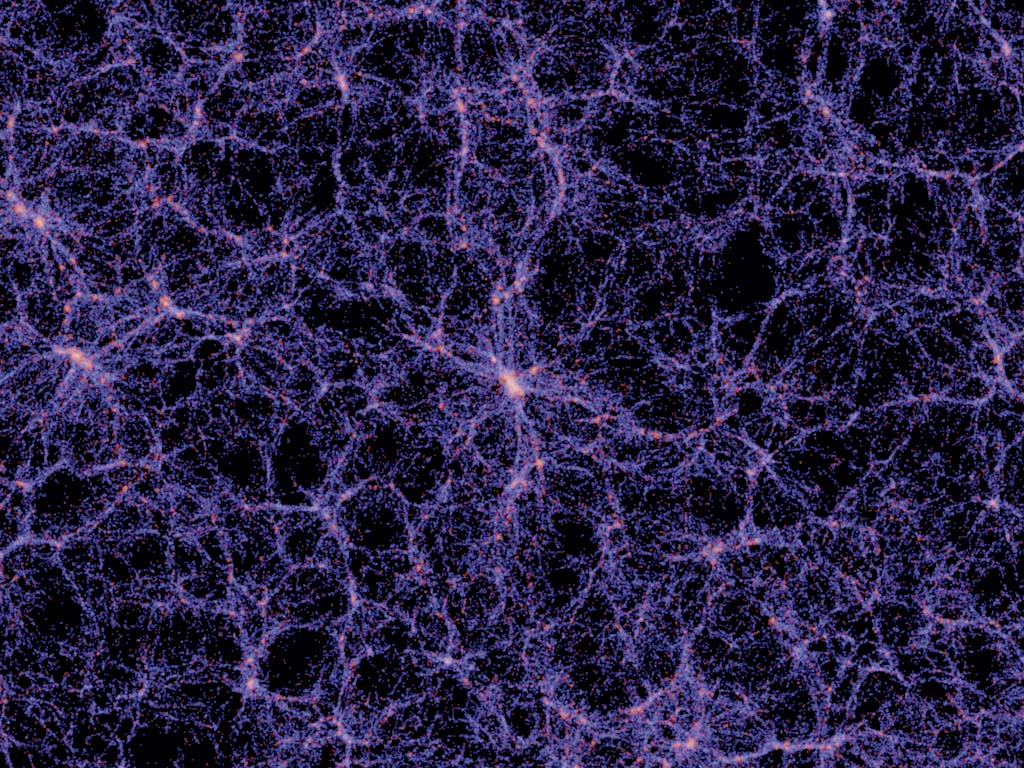
Ever since I saw the peculiar, foam-like arrangement of galaxies, I was intrigued.  Here is an example of what I'm referring to.  Every point of light in this image is an entire galaxy.


This inspired me to create a fly-through visualization that lets you explore nearby stars, galaxies and galactic clusters.  Please be patient while it loads all the data, there's 4MB of galactic cluster data and 2MB for the stars, so it takes a minute or so the first time you load it.
* http://marklipson.com/code-samples/galaxies1/galaxies.html

My favorite is the "galaxy" view - you can see the clustering of galaxies, and you can more or less see the filaments and voids.  The "cluster" view may not quite be correct yet, and the radii and brightnesses could all use some work.  But it gives you a sense of where we are in the universe, which was its purpose.  If any programmers or astronomers feel inspired to help, the code is here.


For a more visually gratifying fly-through, here is one based on the terabytes of data gathered by SDSS:
* http://www.youtube.com/watch?v=08LBltePDZw

Here's a great little demonstration of the scales involved:
* http://htwins.net/scale2/

And I can't help but include a link to this article about what might lie beyond the meager confines of the observable universe:
* http://scienceblogs.com/startswithabang/2010/10/27/how-big-is-the-unobservable-un/


Thursday, May 23, 2013

Prime Roots

What's in a number?  Well, prime roots, for one thing.  I'm sure there are many other "significant" ways to understand a given integer, but prime roots seem like they get at some kind of fundamental essence.  Take 12, for instance.  2, 2 and 3.

Just for fun, let's pretend that quarks represent prime numbers.  If up quarks were "2", and down quarks were "3", that would give you a proton, so a proton would be 12.  A neutron would be 18, since it has 2 down quarks and 1 up quark (2, 3 and 3).  We might have to create some imaginary quarks to go much further, but this obliquely conveys my excitement about prime roots being "fundamental building blocks of numbers".

Not seeing a particularly simple prime root calculator, I created this:
  prime root finder